Journaling for Relaxation Simple Daily Writing Habits to Calm Your Mind

A restless mind can make even quiet moments feel loud. You sit down after a long day, but your thoughts keep moving: the message you forgot to answer, the errand you need to run, the thing you wish you had said differently.
Journaling gives those thoughts somewhere to land.
You do not need a perfect notebook, a long morning routine, or a talent for writing. A few honest lines can help you slow down, notice what you feel, and create a little space between you and the stress of the day. Journaling for relaxation works best when it feels simple enough to repeat, even when life is full.
This guide shares calm, practical writing habits you can use daily. Think of them as gentle tools, not rules.

Why journaling helps the mind settle
Stress often grows when thoughts stay vague. A worry can feel huge when it circles in your head, but more manageable once you write it down in plain language.
Journaling can help in a few simple ways:
It slows your pace because writing by hand takes time.
It gives shape to feelings that may be hard to name.
It helps you separate facts from fears.
It creates a small pause before reacting.
It can become a steady ritual at the start or end of the day.
The goal is not to solve every problem on the page. Some days, the page is just a place to unload. Other days, it helps you see one clear next step.
Writing also helps because it creates a private space. No one has to approve your thoughts. No one has to grade your sentences. You can be messy, repetitive, uncertain, or emotional. That freedom is part of what makes the practice calming.
A journal does not replace mental health care. If stress, anxiety, sadness, or sleep problems feel intense or ongoing, support from a qualified professional can help. Journaling is a supportive habit, not a substitute for care.
Build a journaling habit that feels easy to keep
The most relaxing journaling habit is the one you can actually do. A routine that sounds impressive but takes 45 minutes will likely disappear when life gets busy.
Start smaller than you think you need to.
Choose a time that already has a natural pause
A daily habit sticks better when it attaches to something you already do. Pick a moment that has a built-in transition.
Good times to journal include:
After waking up, before checking your phone
During a lunch break
Right after work or school
After dinner
Before bed
While waiting for tea or coffee to brew
Even two minutes counts. The mind relaxes through repetition, not performance.
If mornings feel rushed, do not force a morning practice. If evenings make you sleepy, keep your journal near a favorite chair and write before you get too tired. The right time is the one that fits your real life.
Keep the materials simple
A plain notebook and a pen are enough. You can use a notes app if that feels more natural, but handwriting often encourages a slower pace. The physical motion can feel grounding.
Try to keep your journal visible. Place it somewhere calm and ordinary, such as:
A bedside table
A basket near the couch
A kitchen shelf
A bag you carry daily
Avoid turning the setup into a project. If finding the “perfect” journal delays the habit, use whatever paper you already have.
Set a low daily minimum
A low minimum removes pressure. Try one of these:
Write three sentences.
Fill five lines.
Set a timer for three minutes.
Answer one prompt.
List one feeling and one need.
Once you start, you may write more. If not, you still kept the habit.
That matters. A relaxing journal should not become another task you feel behind on.
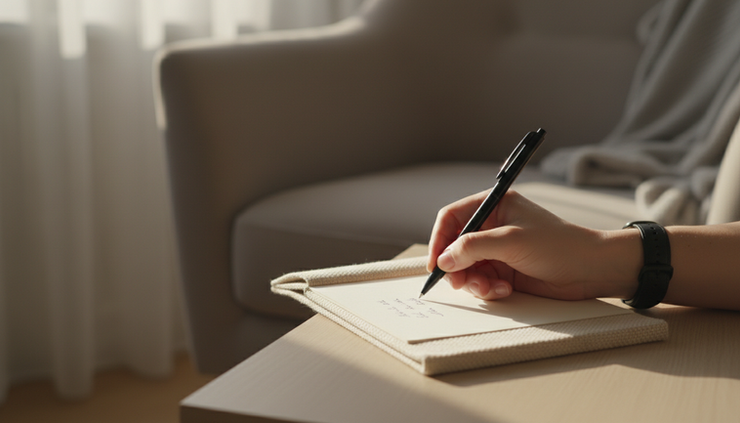
Use simple prompts when your mind feels crowded
Blank pages can feel too open, especially when you are tired. Prompts give your thoughts a starting point. They also keep you from turning journaling into overthinking.
Use the prompt that matches the kind of stress you feel.
When you feel overwhelmed
Try writing:
Right now, my mind is carrying...
Then list everything, without sorting it. Include small things. Include things that seem silly. The point is to move the mental clutter onto the page.
After the list, write:
The one thing I can handle next is...
Choose something concrete and small. Send the message. Put the clothes in the washer. Drink water. Step outside for three minutes.
This turns a tangled cloud of stress into one reachable action.
When you feel tense in your body
The body often notices stress before the mind names it. Use your journal to check in gently.
Write:
Where do I feel tension?
What might this part of me be asking for?
What would feel soothing right now?
Your answer might be stretching, rest, food, quiet, movement, or a break from screens. The goal is not to judge the tension. The goal is to listen.
When you keep replaying a moment
Loops are common after awkward conversations, mistakes, or hard days. A journal can help you step out of the loop.
Try this structure:
What happened
Write only the facts. Keep it plain.
What I am telling myself about it
Write the story your mind keeps repeating.
Another fair way to see it
Write a kinder or more balanced version.
This does not mean pretending something did not hurt. It means giving your mind more than one angle.
For example, “I ruined that conversation” might become, “I felt nervous and stumbled over my words. The conversation was uncomfortable, but that does not mean I failed.”
When you cannot sleep
Bedtime journaling works best when it is brief and practical. Long emotional writing right before bed may wake your mind up instead of calming it.
Try a sleep-focused page:
Three things I can leave for tomorrow
One thing I did well enough today
One thing I need to remember
One calming sentence for tonight
A calming sentence can be simple:
I do not have to solve everything before morning.
Write it slowly. Let it be enough.
Try daily formats that keep writing gentle
One reason people stop journaling is that every entry starts to feel like a full personal essay. Relaxing journal habits are usually lighter.
Here are a few formats to rotate through.
The three-line reset
This is helpful when you have almost no time.
Write three lines:
I feel...
I need...
I will...
Example:
I feel scattered and tense.
I need quiet and a clear next step.
I will put my phone away for 20 minutes and make dinner.
This format works because it moves from awareness to care to action.
The brain dump
Set a timer for five minutes and write everything that comes to mind. Do not worry about grammar, order, or tone. If you get stuck, write, “I do not know what to write,” until the next thought appears.
When the timer ends, read nothing back if you do not want to. The benefit is in the release.
If the page feels heavy afterward, add one closing line:
For now, I can let this sit here.
That small sentence can help create distance.
The gratitude and relief list
Gratitude can be helpful, but it should not force false cheer. On hard days, “things I am grateful for” may feel too bright. Try “things that gave me relief” instead.
Examples:
Warm socks
A quiet drive
A kind text
Leftovers for dinner
Ten minutes alone
The first sip of coffee
Relief is often more accessible than joy. It still trains attention toward what supported you.
The unsent letter
Write to a person, a situation, your past self, your future self, or even the day itself. Do not send it. Do not polish it. Let the letter say what needs to be said.
You might begin with:
I wish I could say...
I am tired of holding...
What I needed then was...
I am ready to forgive myself for...
Unsent letters can be powerful because they allow expression without immediate consequences. If the writing feels intense, close with grounding. Name five things you see, take a slow breath, or step away from the page.

Make your journal a calm place rather than a perfect record
A journal can become stressful if you treat it like an archive of your best thoughts. It does not need to be neat. It does not need daily dates, matching pens, or complete sentences.
Give yourself permission to write badly. Cross things out. Repeat yourself. Skip days. Start again in the middle of a page.
The journal is not there to prove consistency. It is there to support you.
Protect privacy so you can be honest
Relaxation depends on honesty, and honesty depends on feeling safe. If privacy is a concern, choose a method that helps you relax.
You can:
Keep the journal in a drawer
Use initials instead of names
Tear out pages after writing
Use a password-protected notes app
Write briefly instead of in detail
Some people enjoy rereading old entries. Others never reread them. Both approaches are fine. If rereading makes you spiral, skip it. The practice can be about release, not review.
Notice when journaling turns into rumination
Journaling should help thoughts move, not trap you in the same loop. If you write the same worry for many pages and feel worse afterward, shift the format.
Try one of these closing questions:
What is one fact I know?
What is one thing I cannot know yet?
What is one kind thing I can do for myself now?
What is one small action that would support me?
You can also set a timer. Give the worry ten minutes, then end with a grounding line.
For example:
I have given this thought space. Now I am returning to the present.
That kind of boundary keeps journaling from becoming another form of stress.
A simple seven-day plan to start
If you want a clear beginning, use this plan for one week. Keep each entry short, around five minutes.
Day | Prompt |
Monday | What is taking up the most space in my mind today? |
Tuesday | Where do I feel tension, and what might I need? |
Wednesday | What can I make easier for myself this week? |
Thursday | What is one thought I can set down for now? |
Friday | What helped me get through the day? |
Saturday | What do I want more of in my daily life? |
Sunday | What can I release before the new week begins? |
At the end of the week, do not grade yourself. Just notice what happened. Did you feel a little lighter after writing? Did one prompt help more than the others? Did a certain time of day feel easier?
Use what you learn. Leave the rest.

Keep the habit kind and flexible
Journaling for relaxation is less about writing every day forever and more about having a place to return when your mind needs room.
Some days, your entry may be one sentence:
I am tired, and I need rest.
That counts.
Some days, you may fill pages. That counts too.
The best practice is one that feels like support, not self-improvement pressure. Start with three lines. Use prompts when you feel stuck. Let your journal hold what your mind keeps carrying.
A calm mind does not always come from having fewer thoughts. Sometimes it comes from giving those thoughts a safe place to land.


Comments